Three knives that are enough for most kitchens
Three knives that are enough for most kitchens
There are more than 20 types of Japanese kitchen knives. Each has its own purpose and a design tailored to it. Some Japanese knives can handle the vast majority of tasks in a regular kitchen, while others would be difficult to find a use for. Although I personally love the appearance and story of the knife specialized for processing eels, the Unagisaki, I don’t think that, like 99.9% of people, I will need one anytime soon. In the following article, I would like to introduce you to a trio of knives that I am convinced will find a use in every kitchen.
TL;DR
Santoku / all-purpose knife for most tasks
Nakiri / vegetables and work on the cutting board
Petty / smaller and precise tasks
Together, this trio covers most everyday kitchen tasks
.
.
.
.
.
Why these knives in particular
The following list is not set in stone. It is an overview of a trio of knives that, in my opinion, together form the perfect cocktail of qualities. They are versatile and complement each other beautifully in character. That does not mean that your dream setup of Japanese knives cannot be completely different. I discuss other possible combinations of knives, based around the main ingredients in your menu, in more detail in the article: Knife set vs. individual knives: which makes more sense. To me, these are simply a kind of holy trinity of Japanese knives for ordinary people to use. Whether families with children, young couples, or enthusiastic home cooks. Knives that will never get in the way or gather dust, and that everyone will love.
Santoku – a medium-sized knife for everything and everyone
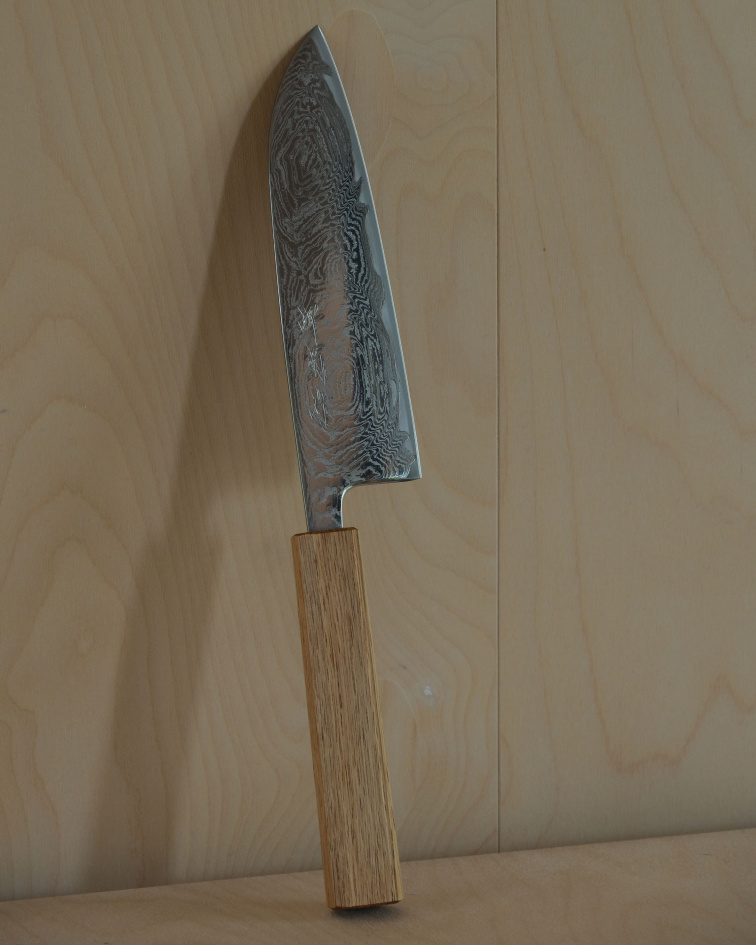
The Santoku knife pattern originated in Japan sometime around the 1940s–50s. This was a period when Japanese culture was becoming the most Westernized. Variations on European dishes were beginning to find their way into more and more Japanese homes. Demand began to grow for a kitchen knife capable of confidently preparing Japanese fusion dishes at home. Santoku met everything ordinary Japanese people of the time required from an all-purpose knife.
A practical length
The standard blade length for a santoku became 165 mm. This number is not accidental. A length of 165 mm represents the maximum possible blade size with which preparing even larger quantities of food remains comfortable and easy, even on small Japanese kitchen counters. However, it does not have to stay in Japan—small kitchens are common in Europe too, where the Santoku quickly became popular thanks in part to its convenient size. Thanks to its blade length, the Santoku feels compact yet confidently full-size in the hand. It will not feel out of place on a small cutting board, and preparing even large quantities of ingredients with it will not be a chore.
Blade shape and geometry designed down to the last detail
The Santoku has a double bevel so that anyone can use it. Right-handed and left-handed users alike. The blade geometry is very thin and allows the knife to glide smoothly through any meat, fish, vegetables, fruit, plant proteins, and other ingredients. The Santoku is a light, well-balanced knife, making it feel nimble and fast in the hand.
Summary
Anyone can use the Santoku for everyday cooking. A demanding cook, tired parents, guests, and people who feel apprehensive about working with large, pointed knives. What more is there to say? The expertise of Japanese craftspeople and the Western need for versatility have created perhaps the most practical knife in the history of modern gastronomy.
Nakiri – the knife that makes vegetable preparation a joy
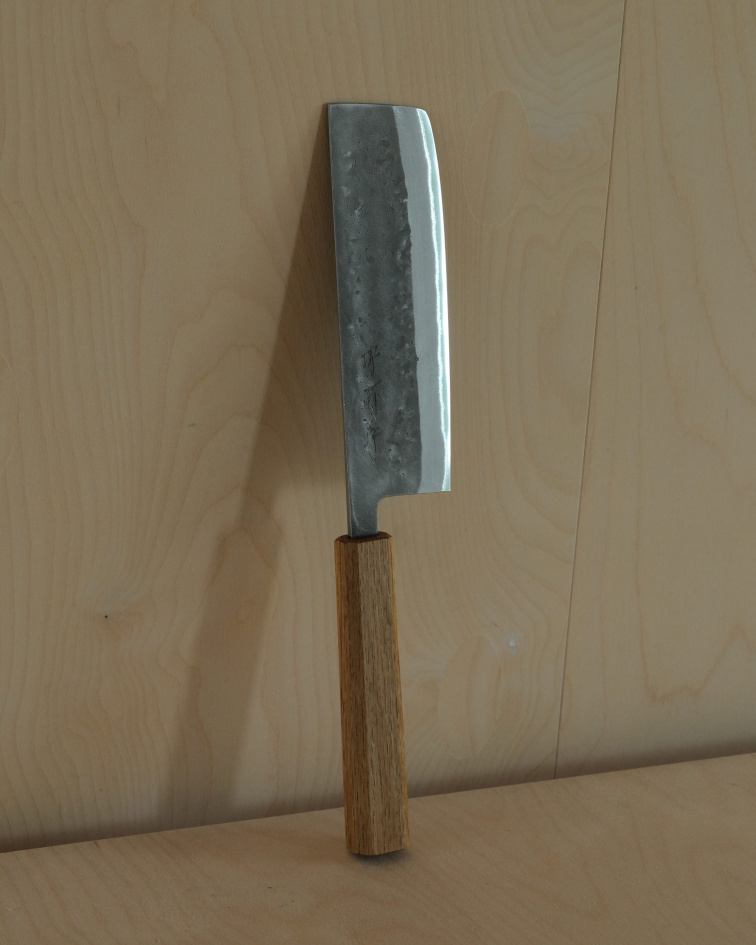
The Nakiri strikes me as a must-have knife for every kitchen, including those focused on meat or traditional European cuisine. Vegetables form the basis of almost every type of cooking, and this knife excels at preparing them easily and precisely. It is suitable for cutting vegetables into thin, long strips for a wok, as well as into small cubes for French mirepoix, Italian soffritto, or German suppengrün.
A straight edge without a tip
The traditional length of the Nakiri is around 165 mm. Unlike its predecessor, the Usuba, it has a thin double bevel, making it suitable for right-handed and left-handed users, as well as users without specialized cutting know-how. Its characteristic features are a completely straight edge and a square blade without a traditional tip. This shape is designed for a top-to-bottom cutting technique (push-cut and chop-cut). Thanks to the straight profile, the entire edge touches the cutting board at once.
A tall profile and thin blade
The tall blade gives you excellent control and support for the knuckles of your other hand, which significantly speeds up and makes the work more pleasant. The bevel is usually flat and very thin, so the knife does not crack or crush ingredients, but glides smoothly through them. The blade’s width is also practical after cutting ingredients—you can easily scoop up chopped onions, herbs, or vegetables with it and transfer them directly into a pot or pan.
Summary
The Nakiri makes the least popular part of cooking more efficient: the lengthy chopping of vegetables. It is a knife that will not help with filleting fish, but in what it was created for, it is irreplaceable.
Petty – short, fast, nimble
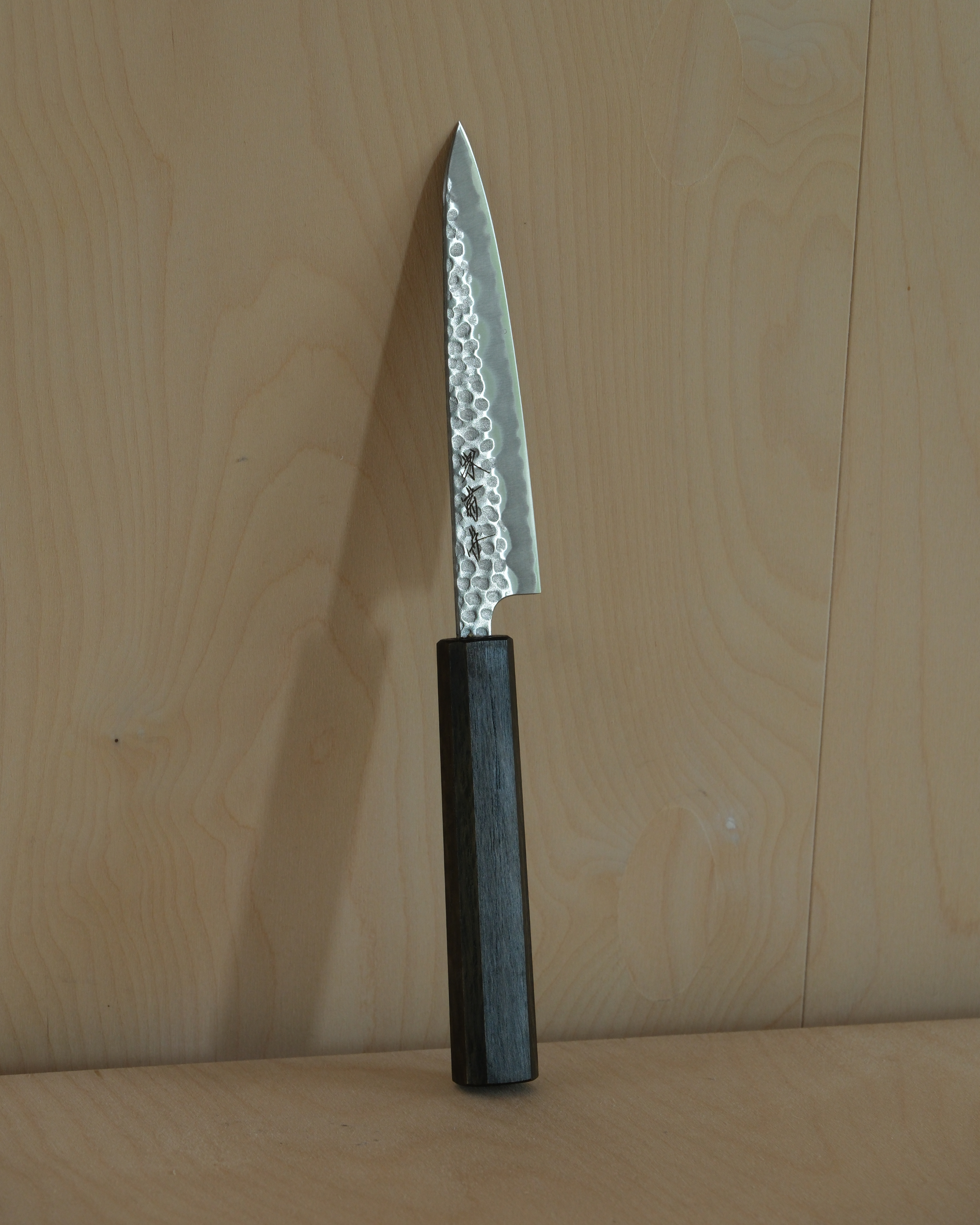
While the Santoku and Nakiri handle most work on the cutting board, there are tasks where large blades are more of a hindrance. This is where the Petty comes in—the Japanese interpretation of a versatile small knife (similar to Western paring or utility knives).
Compact dimensions and a narrow blade silhouette
The blade length of a Petty knife usually ranges from 120 to 150 mm. It is light, slim, and incredibly nimble. Thanks to its dimensions, it works excellently not only on a cutting board, but especially “in the air”—that is, directly in your hand. The fine tip and narrow profile give you control over every millimeter of the edge.
Precision and detail
The Petty is a master of detail. It can peel fruit, remove cores, peel garlic and shallots, clean mushrooms precisely, or remove silver skin from smaller pieces of meat. It is equally ideal for small aesthetic adjustments, such as carving decorations from vegetables or finely slicing strawberries. When used, it feels like an extension of your hand, and thanks to its lightness, it will not tire you during work.
Summary
The Petty is a knife for tasks where the Santoku and Nakiri are too large. It is an invaluable knife for small tasks, cleaning, and any detailed preparation before cooking itself.
Find out more about other types of Japanese knives in the article: A guide to types of Japanese knives.
Why are these three knives the perfect combination?
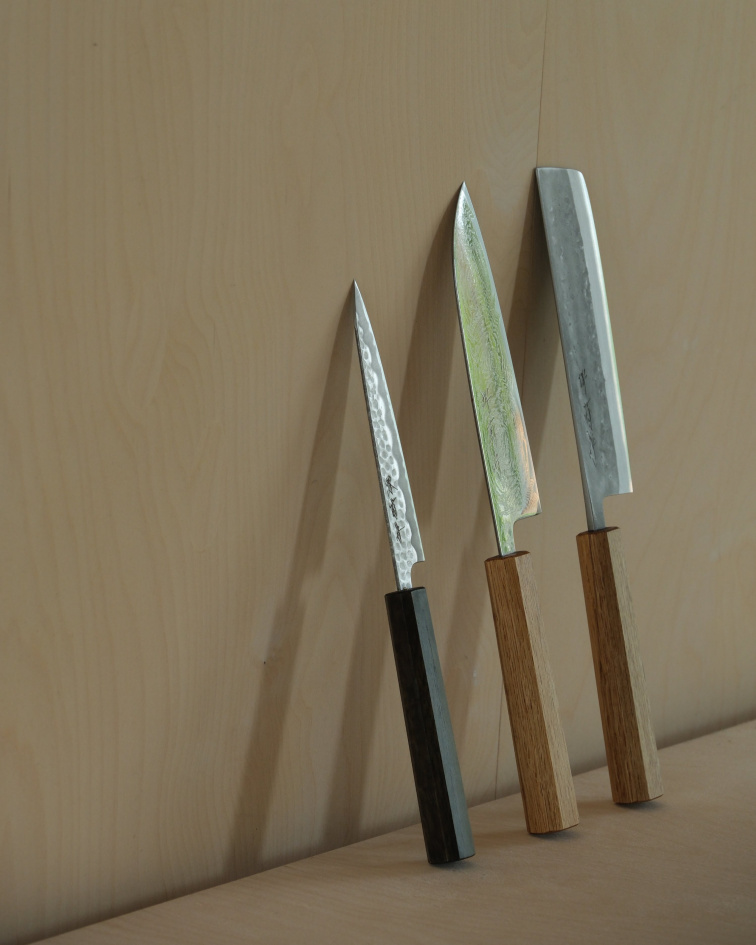
The magic of this setup lies in the fact that the knives complement one another. They do not duplicate each other, they do not conflict, and functionally they cover most situations you face in the kitchen:
The Santoku is your everyday knife for volume, meat, fish, and general cutting.
The Nakiri is a specialist for the fast, precise, and comfortable preparation of any vegetables.
The Petty complements larger knives with its precision for small tasks, peeling, and work away from the cutting board.
Thanks to this trio, you will not lack anything in the kitchen, nor will anything get in your way. Each knife in this set has a clear role in which it excels.
In conclusion
Choosing kitchen knives does not have to be complicated, and you certainly do not need to spend a fortune on twenty-piece sets. If you are starting out with Japanese knives or want to reduce your kitchen equipment to the essentials, this trio—Santoku, Nakiri, and Petty—provides a foundation that will always serve you well. It will save space on your countertop, speed up food preparation, and, above all, transform the frustrating preparation of ingredients into a calm ritual.
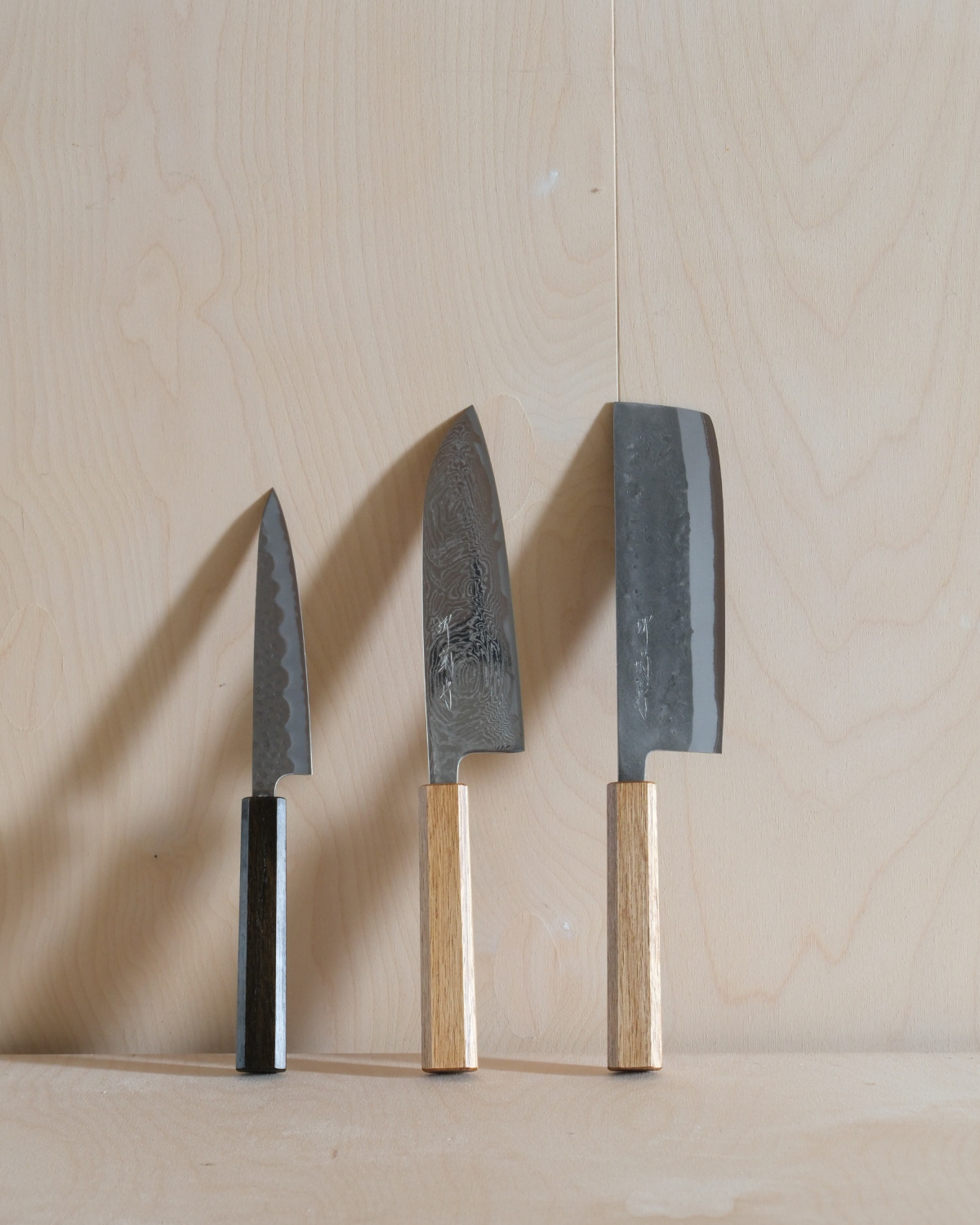
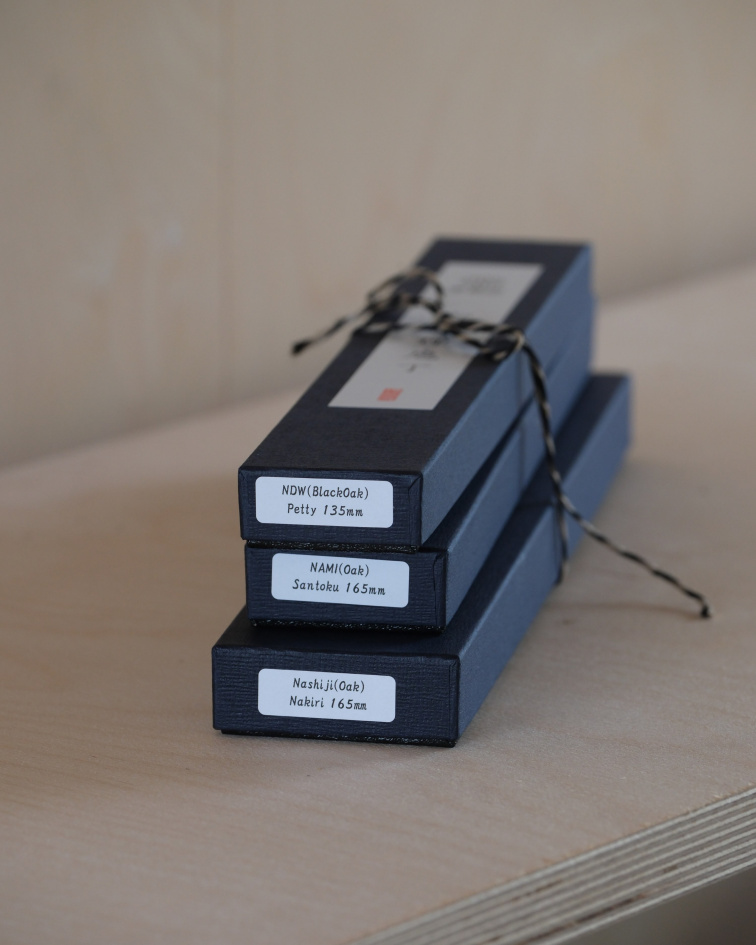
Knives in the photographs: Sakai Kikumori NAMI Santoku 165 mm, Sakai Kikumori Nashiji Nakiri 165 mm, Sakai Kikumori NDW Petty 135 mm
Not sure which knife to choose? Knife / How to choose →
Matouš © Tokyo Tools
FAQ
Which Japanese knife should I start with if I am buying my first one?
The best choice is a Santoku. It is an all-purpose knife for everyday cooking. It can handle meat, fish, vegetables, and other ingredients.
Is a Santoku enough as my only kitchen knife?
Yes, a Santoku can handle the vast majority of tasks and the preparation of even larger quantities of ingredients. For specific tasks, however, it pairs excellently with a Nakiri for vegetables and a Petty for small tasks where larger knives can be awkward.
Do I need a Nakiri if I mainly cook meat at home?
A Nakiri is also excellent for meat-focused kitchens. Vegetables form the basis of almost every type of cooking, including meat dishes. For meat lovers, the Nakiri makes the least enjoyable part of cooking more pleasant—the chopping of vegetables.
What is a Petty better at than a regular small kitchen knife?
The Petty excels through its lightness, slim profile, and small tip. It is exceptionally nimble and replaces large knives for cutting tasks requiring precision, speed, and maximum control over the blade.
What blade length should I choose for a Santoku and a Petty?
Santoku: The standard and most practical length is 165 mm, as it suits every kitchen regardless of its size, and working with it will not be uncomfortable even for less experienced cooks. Larger Santoku knives (170–190 mm) are suitable for those who find a standard Gyuto (with a 210 mm blade) too large, but the 165 mm Santoku feels insufficient.
Petty: The usual length ranges from 120 to 150 mm. The ideal Petty length is highly individual. Generally speaking, I would say that smaller versions suit people with smaller hands, or work with small ingredients and tasks requiring precision. Conversely, if you have larger hands and are looking for a Petty capable of making longer cuts, working with the 150 mm version will feel much more natural.
Is it better to buy three quality knives or a large set?
It is better to buy three quality knives. They cover the vast majority of situations, save space, and you do not have to spend money on unnecessary large sets containing many knives you would never use.
What tasks should I avoid doing with these knives?
I would primarily avoid boning meat and cutting frozen or very hard ingredients, which could risk damaging the blade’s edge.
Can a complete beginner use this trio of knives?
Yes, all three knives have a double bevel (suitable for both right-handed and left-handed users), are easy to control, and thanks to their safe geometry (the Santoku has a rounded spine, while the Nakiri has no sharp tip), they are also suitable for people who are still learning cutting techniques.