
How Toyo Steel boxes work together
How Toyo Steel boxes work together
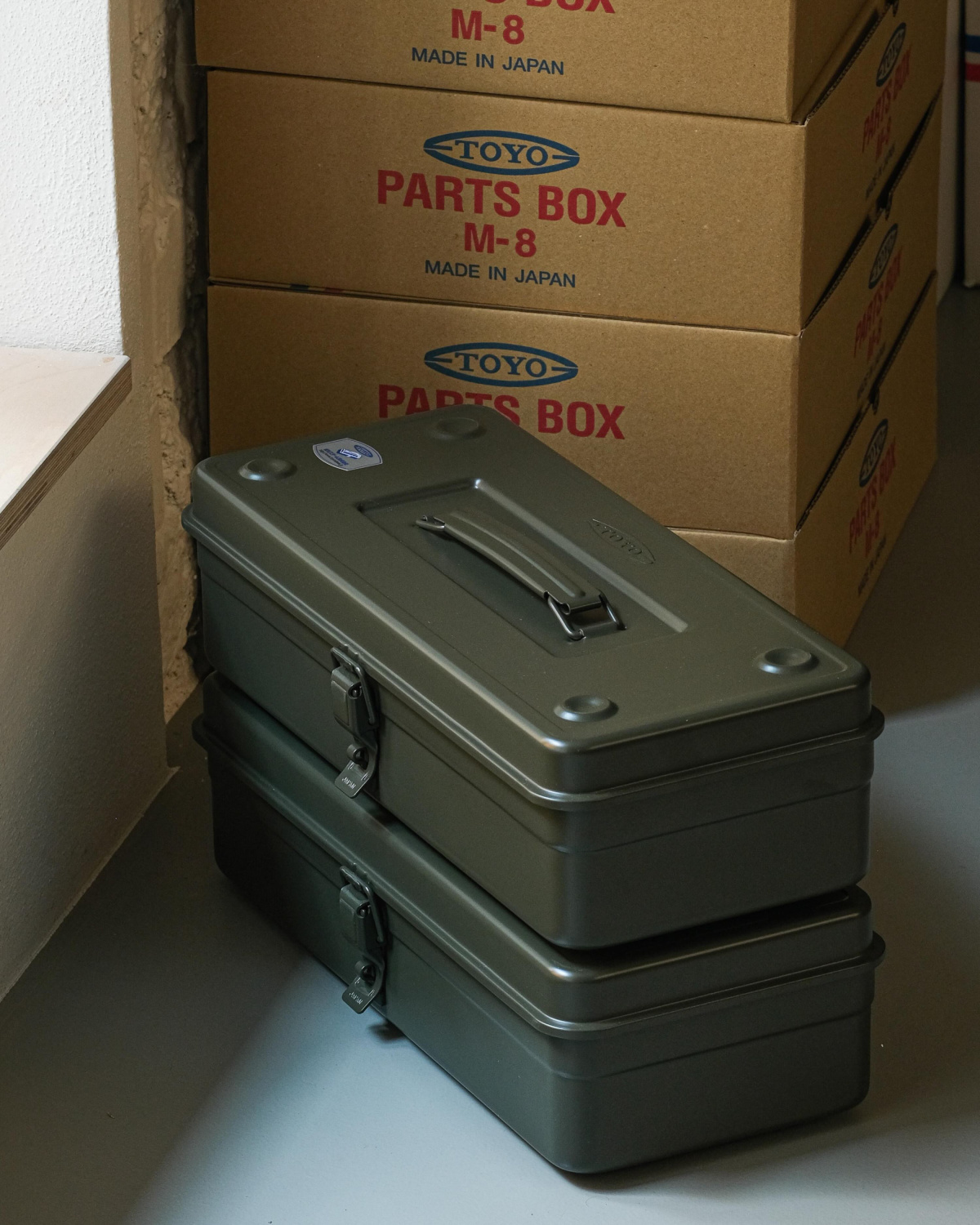
Toyo Steel boxes differ in more than just their dimensions. Some have the same footprint but different heights, while others can be stacked or placed inside one another. T-190 and T-192 differ in height by 21 mm. M-8 uses its own construction for stacking. T-190 fits inside the larger T-360.
Toyo Steel has been manufacturing steel boxes in Osaka since 1969. The basis is sheet steel pressed into a single piece without welds. The other construction solutions are equally straightforward – embossments in the lid, folding handles, or dimensions that allow some models to be stacked on one another.
Article contents
Same footprint, different height
How stacking works
Box inside a box
Start with what you are storing
.
.
.
.
.
Same footprint, different height
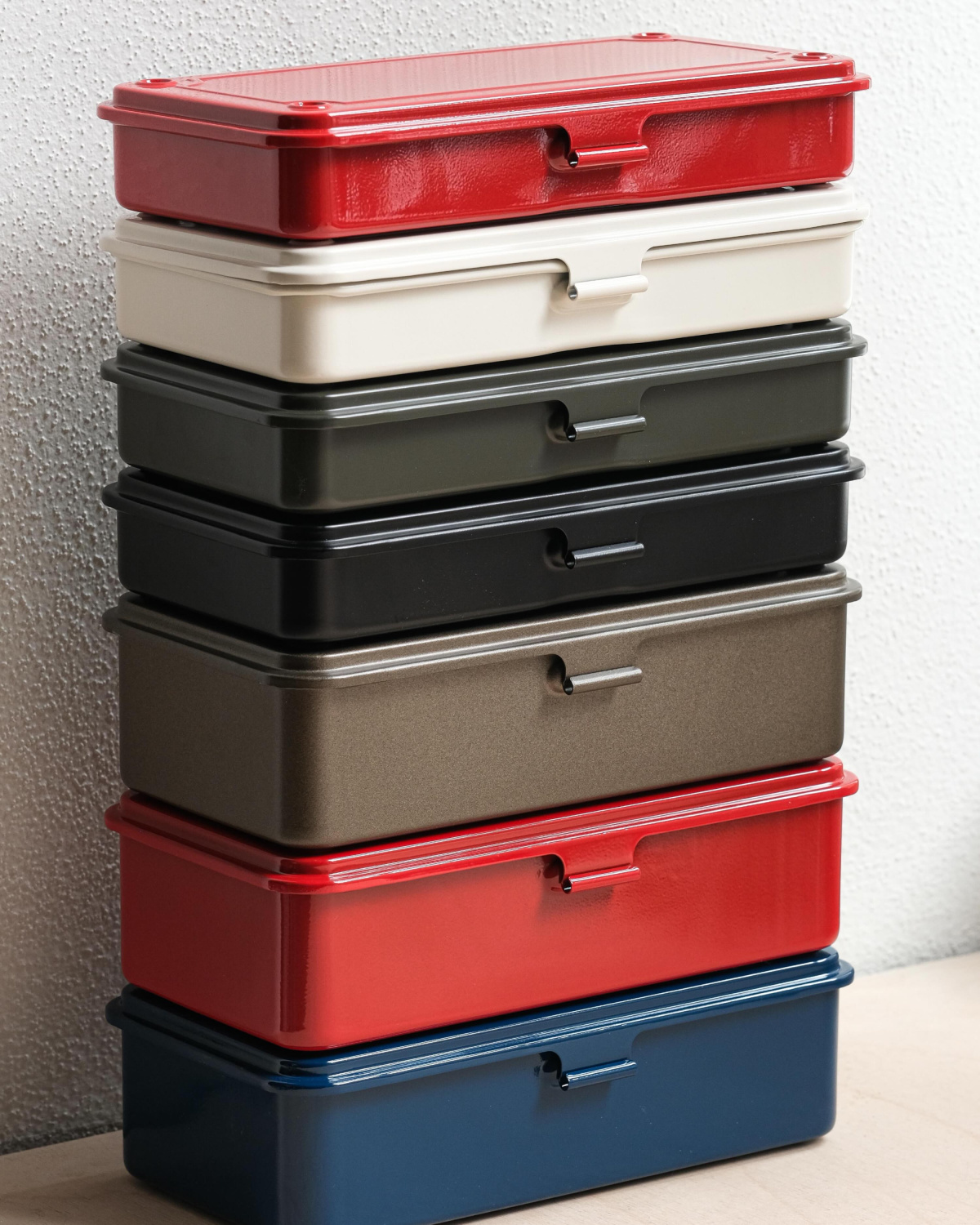
T-190 and T-192 have the same external footprint: 203 × 109 mm. The difference is in their height. T-190 is 56 mm high, while T-192 is 35 mm.
A difference of 21 mm changes how the internal space is used. T-192 holds smaller items almost in a single layer, making them easier to see when opened. T-190 offers greater depth with the same footprint. On a table or shelf, both take up the same amount of space.
We find the same relationship with the smaller T-150 and T-152. The footprint stays the same, while the height and, with it, the internal space change.
How stacking works
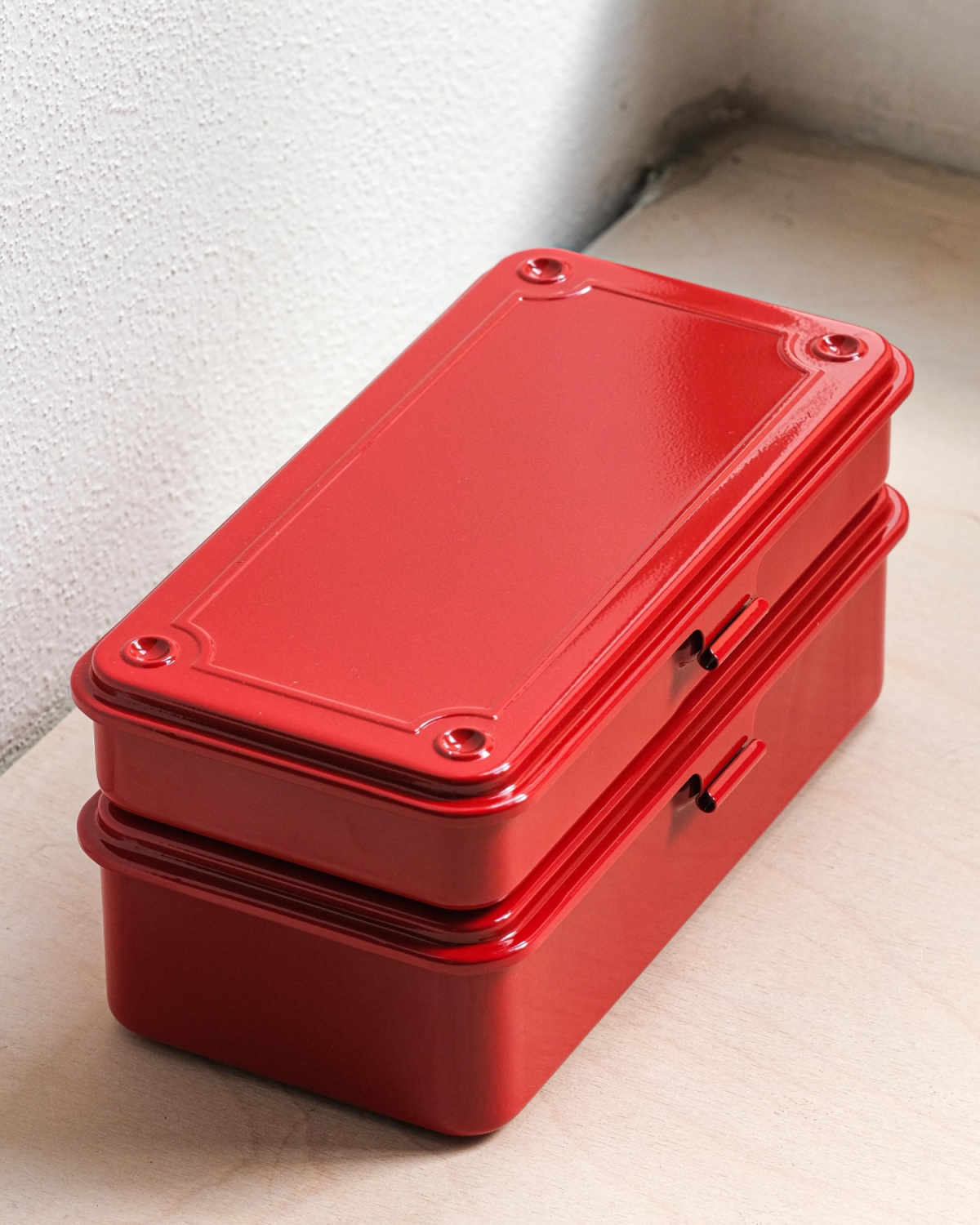
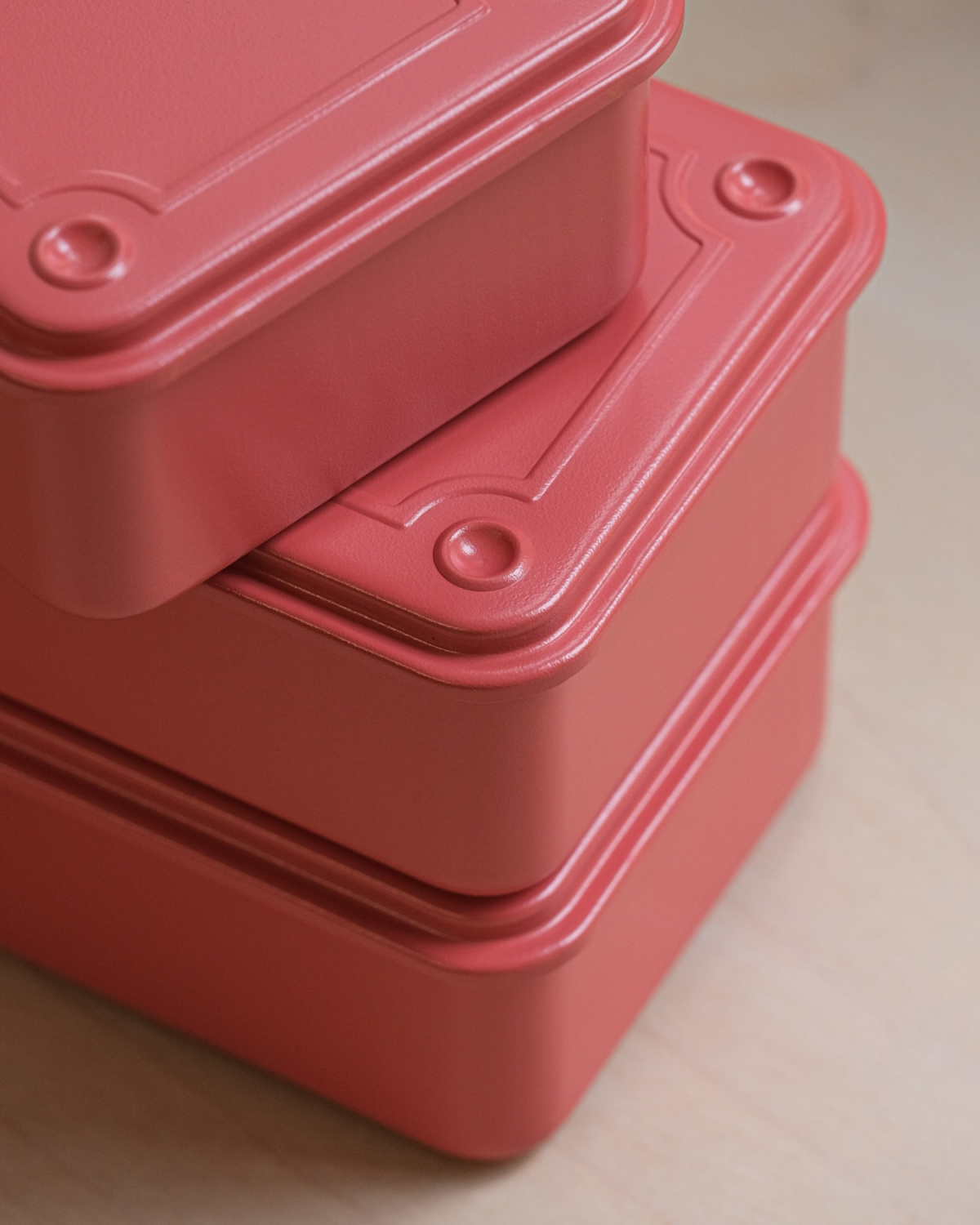
The four circular embossments in the corners of the lid are one of the characteristic features of Toyo Steel trunk boxes. They also serve a structural purpose. In stackable models, the top surface is shaped so that another box can rest on it. There are no plastic connectors, side locks, or additional construction involved.
T-190 can be stacked with T-192, just as T-150 can be stacked with T-152. The models in each pair have the same footprint and different heights. T-350 applies the same principle to a larger format and adds a top handle.
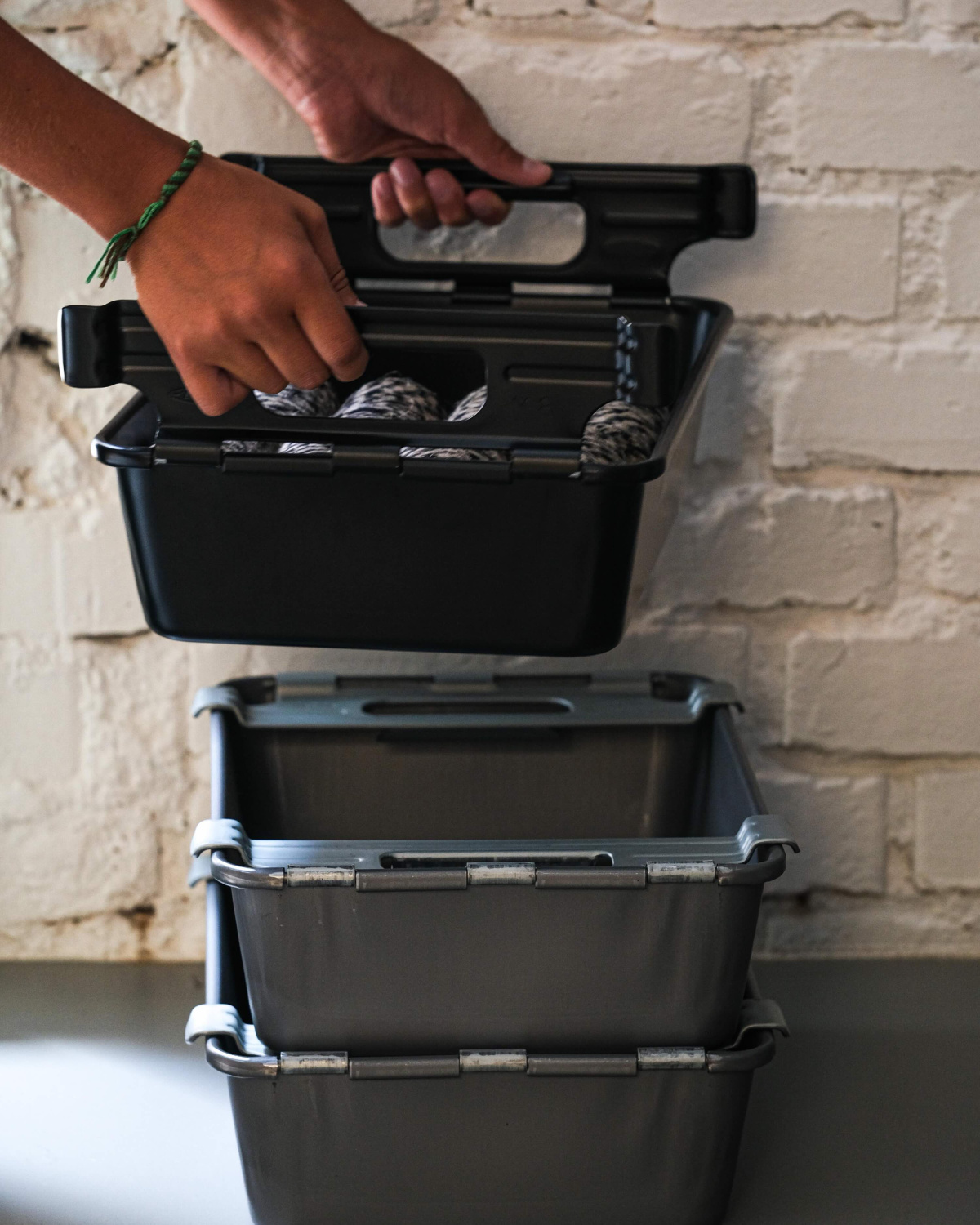
M-8 does not have a lid, so it uses a different construction for stacking. Its tapered body allows full boxes to be placed on top of one another, while empty ones slide inside one another and take up less space.
Box inside a box
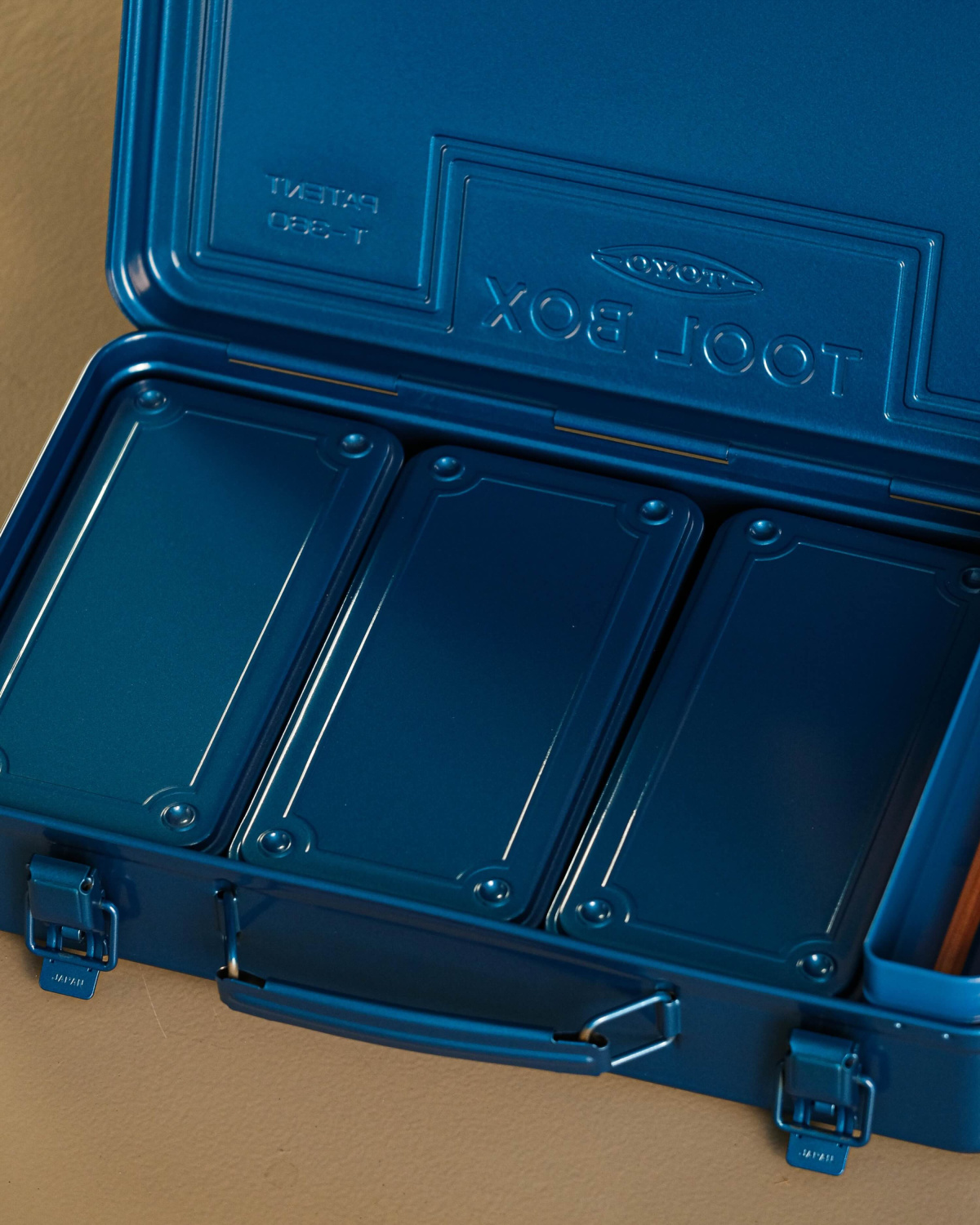
Boxes do not have to work only when stacked. With some dimensions, a smaller model can be placed inside a larger one. One example is T-190 inside T-360. The larger box holds bulkier equipment, while the smaller one creates a separate enclosed space for small items. Compared with a fixed compartment, it has one important advantage: T-190 can be removed, closed, and used on its own.
The layout inside T-360 is therefore not fixed. The smaller box can stay inside, be moved to a work table, or function completely independently.
Start with what you are storing
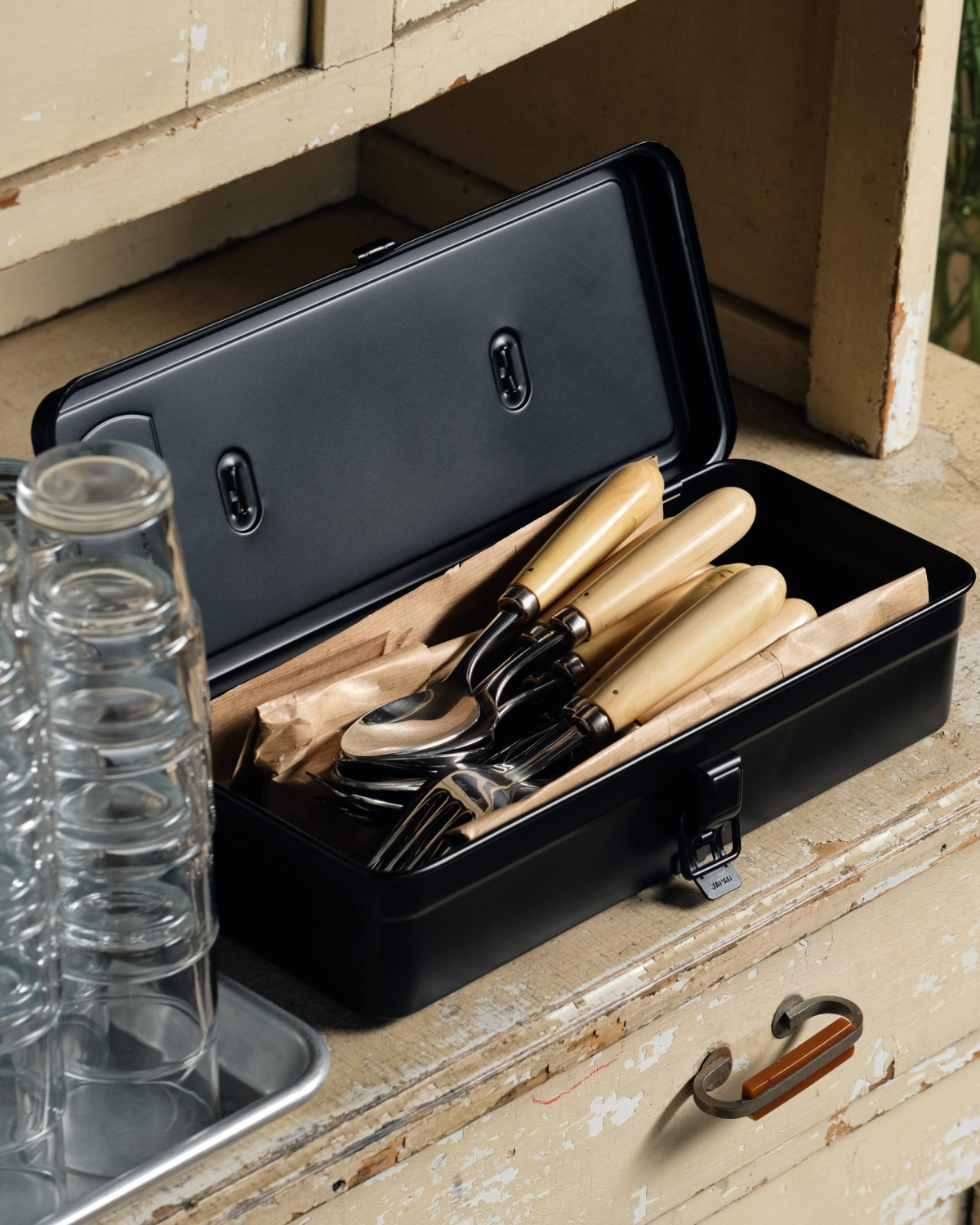
When choosing Toyo Steel, it is more practical to start with the contents rather than the model itself. The dimensions of the items being stored determine the required footprint and height. The way you use them then determines whether one deeper box, several shallow boxes stacked on top of one another, or a smaller box inside a larger one makes more sense.
T-190 and T-192 take up the same area but offer different depths. T-350 adds greater capacity and a handle. M-8 uses its own stacking method. T-190 can function independently or inside the larger T-360.
FAQ
Can all Toyo Steel boxes be stacked on top of one another?
No. Toyo Steel is not one universal modular system. Stacking works between specific models and size ranges. That is why, when choosing, it is useful to consider not only the size of the box itself but also which other models you want to combine it with.
What is the difference between T-190 and T-192?
How do you choose your first Toyo Steel box?
Start with what you actually want to store in it, rather than with the model itself. The dimensions of the items and the way you use them will usually quickly show whether you need a shallow box with an easy-to-see single layer, a deeper version, or a larger toolbox with a handle.
Why are not all Toyo Steel boxes compatible with one another?
Because each model has its own proportions, construction, and character. Toyo Steel was not created as a modular system in which everything has to fit with everything else – if compatibility always took priority, the individual boxes would lose some of their individuality. Some therefore work together, while others simply stand on their own.