Visit our Prague showroom – open Mon–Sat 11:00–18:00. Get directions

Japanese Plane Tsunesaburo Miki 42 mm

Code: TT0453
5 695 Kč
In Stock
Delivery options

Tsunesaburo is a renowned manufacturer of Japanese planes, combining traditional craftsmanship with modern innovations. The plane from the Miki series, equipped with an HSS high-speed steel blade, offers exceptional sharpness, easy maintenance, and excels in working with hardwoods.

Detailed information

Product detailed description

Japanese Plane Tsunesaburo Miki 42 mm

The Japanese plane kanna is a traditional tool used for precision woodworking. Hand planes are the main tools of Japanese carpenters working on the construction of Shinto shrines and traditional wooden houses. They are used to work with wood without leaving scratches and damaging the wood fibers, which could disrupt its "breathing." This method of working is essential to preserve the natural properties and longevity of wood, which is an integral part of traditional Japanese architecture. Due to its efficiency, accuracy, and elegance, the kanna is an indispensable tool in traditional Japanese carpentry. Tsunesaburo, a well-known manufacturer of Japanese planes, offers a unique Miki series. These planes have a blade made from high-speed steel HSS, which holds an edge even better than traditional carbon steel Aogami. This makes the plane from the Miki series particularly suitable for working with hard woods and wood composites. The plane blade is labeled "No need to do uradashi", meaning it is not necessary to perform the traditional uradashi technique, which involves hammering the back of the blade. The cavity is perfectly processed or removed during manufacturing. This significantly simplifies maintenance and sharpening, as there is no need to renew the cavity. This plane is ideal for craftsmen seeking tools with minimal maintenance requirements but high functionality and sharpness. 

Detail

Manufacture: Japan
Brand: Tsunesaburo
Model: Miki 42 mm 
Blade width: 42 mm
Body size: 212 x 57 x 27 mm 
Blade type: No need to do Uradashi
Steel: powder high-speed steel HSS
Body material: Japanese white oak

Manufacturer

The company Tsunesaburo was founded in 1947 in the city of Miki in Hyōgo Prefecture. It is known for its wide range of top-quality woodworking products, especially Japanese planes. Under the leadership of the third generation, Mr. Toru Uozumi, Tsunesaburo strives to contribute to the rich tradition of constructing Japanese wooden houses, where planes play a key role. The company combines traditional and modern manufacturing processes and remains steadfastly dedicated to preserving the craft of plane making. It applies a dual approach to innovations: on one hand, it uses the most advanced technologies for steel forging, on the other hand, it honors the original sword-making techniques introduced by its founder.

JP Tsunesaburou Co., Ltd., 2151 Fukui Hachimantani, Miki City, Hyogo Prefecture, 673-0433, Japan, +81-794-82-5257, office@tsune36.co.jp CZ Tokyo Tools s.r.o., Slovinská 652/19, Praha 10, 10100, CZ, 773707811, www.tokyotools.cz, info@tokyotools.cz

Material

The blade is made from wear-resistant powder high-speed steel HSS, specially designed to be easier to maintain and retain sharpness for a long time. The body is made from Japanese white oak. 

Note: Delivered in original packaging. 

Maintenance

Maintenance of a Japanese plane involves regular sharpening of the blade on whetstones and checking the flatness of the base, which should be adjusted as needed for perfect contact with the surface. It is important to protect the wooden body of the plane from moisture and occasionally treat it with oil to prevent deformation. With proper care, the kanna will provide long life and precise results.

Usage

The Japanese plane kanna is a traditional tool used for precise woodworking. Unlike Western planes, the kanna is used by pulling it towards you, which allows for greater control and precision while planing. It has a simple yet ingenious construction: a wooden body (dai), a main blade (kanna-ba), and a chip breaker that helps control the shavings.

The thickness of the shavings in a Japanese plane kanna is regulated by manually adjusting the blade. A deeper-set blade creates stronger shavings, while a less-set one produces finer ones. For precise adjustment, the blade is lightly tapped with a wooden mallet — tapping from above moves it deeper, while tapping on the back of the plane body slightly pulls it out.

Before first use, the Japanese plane must be properly set up, which may take about 1–2 hours. This process includes flattening the back of the blade, sharpening the edge, adjusting the chip breaker for proper function, and fine-tuning the plane body. Setting up is quite complex, but it not only shows the craftsman how the plane works properly, but also provides a deeper understanding of its construction and the subtle details that affect the quality of the work. Proper plane setup is essential for its optimal performance and long lifespan.

Japanese Plane Tsunesaburo Miki 42 mm

Slow Craft, Deep Focus

A tribute to the art of conscious creation, slowing down in the studio, focused work in the carving workshop. 
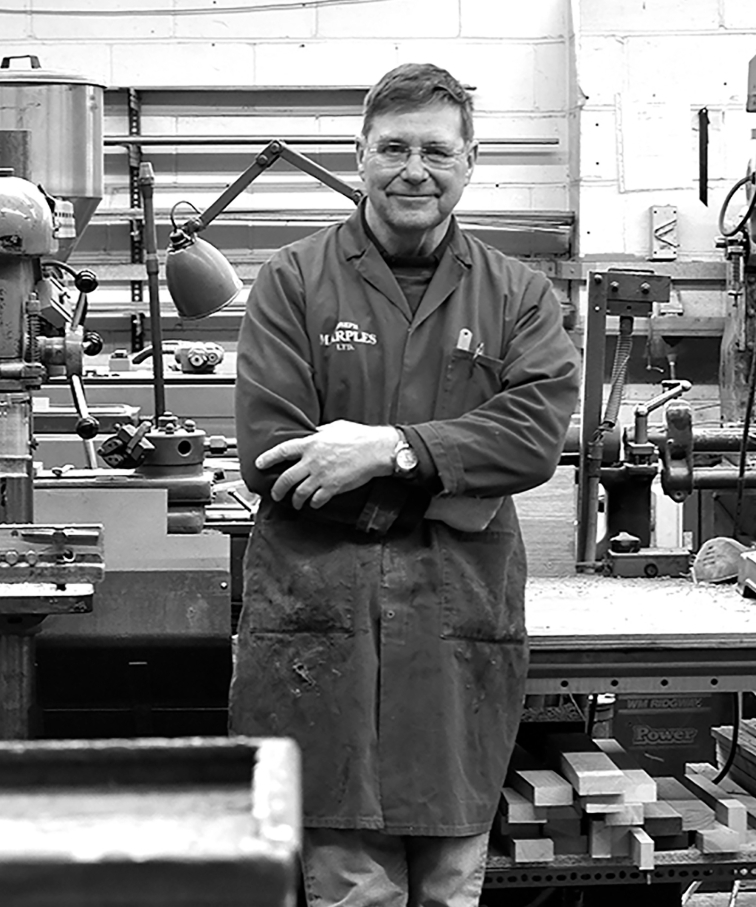
Japanese Plane Tsunesaburo Miki 42 mm

Tags: Joseph Marples England

The family-owned English company is proof that truly precise products withstand the test of time. 

Japanese Plane Tsunesaburo Miki 42 mm

Matěj Sysel from Gas & Oil Motorcycles

Under the brand Gas & Oil, Matěj builds custom motorcycles. When he encountered the Café Racer culture, it was love at first sight.

Additional parameters

Category: Atelier
Use: Woodworking
Tool Type: Chisels
Material: Carbon steel
Origin: Japan

Discussion

Be the first who will post an article to this item!

Only registered users can submit posts. Please log in or sign up.

Do not fill out this field:

Security check

Společnost Tsunesaburo byla založena v roce 1947 ve městě Miki v prefektuře Hyógo. Je známá svou širokou nabídkou prvotřídních výrobků pro opracování dřeva, zejména japonských hoblíků. Pod vedením třetí generace, panem Toru Uozumi, se Tsunesaburo snaží přispívat k bohaté tradici výstavby japonských dřevěných domů, kde hoblíky hrají klíčovou roli. Společnost propojuje tradiční i moderní výrobní postupy a stále se neochvějně věnuje zachování řemeslné výroby hoblíků. Uplatňuje dvojí přístup k inovacím: na jedné straně využívá nejmodernější technologie pro kování oceli, na druhé straně ctí původní techniky výroby mečů, které zavedl její zakladatel.


Vytvořil Shoptet | Design Shoptak.cz